


The E-E-A-T Checklist from Google
The Google’s E-E-A-T framework, part of their Search Quality Rater Guidelines.
Google uses this framework to evaluate whether a web page provides helpful, reliable, and high-quality content.
The E-E-A-T Checklist:-
- Experience
- Expertise
- Authoritativeness
- Trustworthiness
Google uses the E-E-A-T checklist (Experience, Expertise, Authoritativeness, Trustworthiness) to decide which websites deserve to rank at the top of search results.
The summary is aimed at those who are not into reading longer explanations, below I go into more detail.
Can you use AI to create your content? Ironically No. Google wants to see you are human and you or your colleagues took the photos, and they were not generated by AI. My bio – Charles Willcock.
Summary
Here is what you need to focus on to keep your site performing well:
Prove First-Hand Experience: Show real photos of your work, original case studies, or step-by-step walk-throughs of services you have provided.
Showcase Your Expertise: Highlight staff credentials, professional qualifications, industry certifications, or years in business on your About and Service pages.
Build Reputation & Authority: Encourage satisfied customers to leave reviews (on Google or Trustpilot) and aim to get featured or linked to by reputable industry websites.
Make Trust Plainly Visible: Ensure clear contact information, transparent pricing/terms, a valid SSL security certificate (https), and an updated privacy policy are easy to find.
Keep Content Useful & Original: Write content that directly answers your customers’ questions better than your competitors do, avoiding generic or copied text.
Tip: You don’t need to fix everything overnight—focusing on adding real-world proof (reviews, project photos, and clear author bios) yields the fastest improvements to your site’s credibility.
1. Experience (First-Hand Knowledge)
Does the author have direct, hands-on experience with the topic?
Include original photos, video clips, or sound bites demonstrating actual product use or personal involvement.
Shares specific outcomes, anecdotes, or practical insight that can only come from real-world usage.
There is a lot of irony in Google. It promotes Google Gemini the AI engine, but it actually wants to promote real people with Experience, not people pumping questions in to AI and regurgitating the answers.
Using examples of your work and photos. If you are not aware AI can understand a picture just the same as a human. Clearly if you are an SME you are not going to have the resources to appear on 20 social media platforms but being on one or two will help.
Here is how to expand on the Experience pillar specifically for an SME:
1. Document the “Messy Middle” of Real Work
Generic articles tell people what to do. Experience shows how it actually happens when things don’t go according to plan.
- Before-and-After Case Studies: Instead of writing a generic blog post like “How to Repair a Commercial Roof,” write “Replacing a Damaged Factory Roof in Manchester During Heavy Rain.”
- Troubleshooting & Edge Cases: Share the specific, unexpected challenges your team encountered on a job site and how you solved them.Example: “Most manuals say to set the torque to X, but on 10-year-old pumps like these, we’ve found you need to…”
- Failure Lessons: Admitting what didn’t work on a project and how your team pivoted demonstrates authentic, un-fakeable field experience.
2. Unfiltered “In the Field” Media (Low Production, High Authenticity)
You don’t need high-end film crews. In fact, slightly raw, real media carries a stronger “Experience” signal than overly polished stock footage.
- Smartphone Photos on the Job: Action shots of your engineers, builders, accountants, or chefs actively doing their jobs.
- Short Video Clips (15–30 Seconds):
- A quick clip of a machine operating after a repair.
- A technician explaining a worn-out part directly to the camera.
- A 360-degree sweep of a finished installation.
- Audio Snippets / Voice Notes: Embed short voice note summaries or clips from team debriefs explaining how a complex client problem was solved.
3. “Day in the Life” & Process Transparency
Showing how your 5 to 25-person team operates day-to-day gives Google hard evidence of an active business entity.
- Behind-the-Scenes Walkthroughs: Photos or short descriptions of your morning prep, loading the vans, quality-checking inventory in the warehouse, or team strategy huddles.
- Tool & Equipment Roundups: Share the specific tools, software, or machinery your team relies on daily, along with honest personal mini-reviews of why you chose them over alternatives.
4. Nuanced, Local & Niche Insights
Real-world experience always leaves behind unique details that only someone in the local area or specific industry would know.
- Local Nuances: Mention local regulations, regional weather challenges, local soil conditions, or specific building architecture types common to your trade area.
- Industry Jargon Used Correctly: Using the actual slang, part numbers, or shorthand your technicians use on site (explained simply for the client) shows deep familiarity with the trade.
The SME “Experience” Matrix
Copywriter / AI Content (No Experience) | 5–25 Person SME (Real Experience) |
Writes a 1,000-word guide on “How to Install Heat Pumps.” | Shares a 3-minute video of their team fitting a heat pump in a Victorian terrace in Leeds. |
Uses stock photos of smiling actors wearing hard hats. | Uses phone photos of Steve the Engineer holding a worn valve he just replaced. |
Gives generic, textbook advice from top search results. | Explains the specific brand of fittings that fail after 5 years based on 500 local call-outs. |
Uses vague examples like “a typical business.” | Names real local clients or anonymized case studies with exact timelines and measurements. |
Bringing It All Together: The Full E-E-A-T Framework for SMEs
Now that you’ve covered all four pillars, here is how they connect for a 5 to 25-person business:
$$\text{Trustworthiness} = \text{Experience} + \text{Expertise} + \text{Authoritativeness}$$
- Experience (First-hand proof): “We do this work every day.” (Photos, videos, case studies, field insights)
- Expertise (Skill & credentials): “We know what we are doing.” (Trade badges, team qualifications, years in business)
- Authoritativeness (Industry standing): “Others in our field respect us.” (Local press, reviews, supplier links, awards)
- Trustworthiness (Safety & honesty): “We are transparent and reliable.” (Clear contact info, real address, upfront pricing, HTTPS)
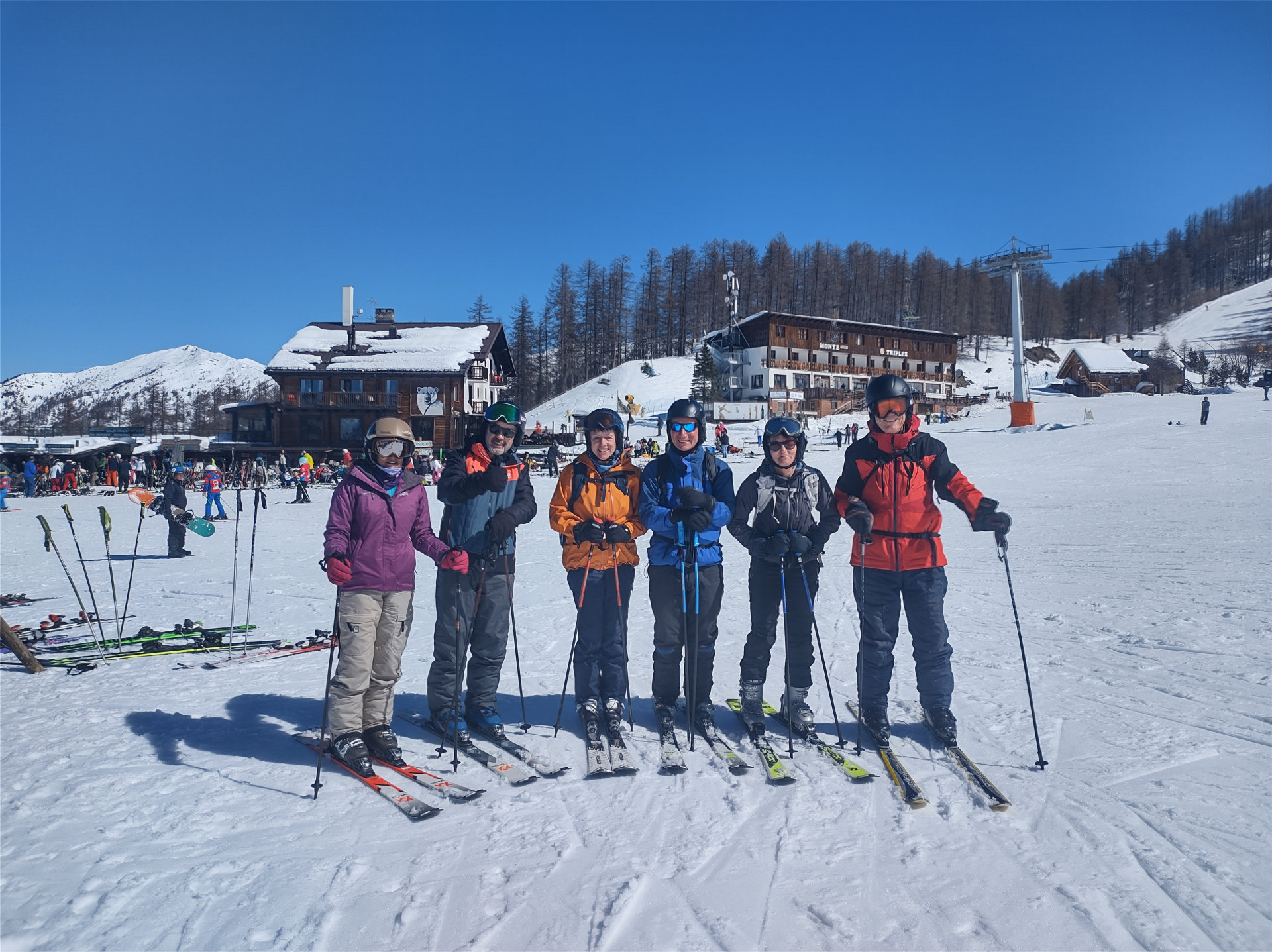
This image shows a group of six skiers posing together on a snowy slope at a ski resort on a bright, clear, sunny day.
The People (Left to Right)
- First Skier: Wearing a purple jacket, cream/tan ski trousers, a helmet, goggles, and holding ski poles.
- Second Skier: Wearing a dark blue/grey patterned jacket, dark trousers, a dark helmet, and giving a thumbs-up gesture to the camera.
- Third Skier: Wearing a bright orange/yellow jacket, dark trousers, and a blue helmet.
- Fourth Skier: Wearing a bright blue jacket, dark trousers, blue-tinted goggles, and a dark helmet.
- Fifth Skier: Wearing a dark grey/black jacket, dark trousers, and a helmet.
- Sixth Skier: Wearing a bold red-orange and black jacket, dark trousers, a black helmet, and orange-tinted goggles.
All six are fully geared up with skis attached, boots, ski poles, helmets, and protective eye gear.
The Environment & Background
- Foreground/Terrain: A flat, well-groomed snowy area with faint ski tracks running across the snow.
- Buildings: Directly behind the group stand two alpine chalets/lodges:
- To the left, a traditional wooden chalet with a snow-covered roof and a white bear logo on the side.
- To the right, a larger multi-story hotel/lodge building with the sign “MONTE TRIPLEX” visible on its facade.
- Ski Infrastructure: A chairlift pylon with an orange protective pad around its base is visible behind the lodges to the right, along with pine-tree-covered slopes in the distance.
- Weather & Sky: A vibrant, cloudless blue sky indicating excellent ski conditions.
Yes, absolutely. The short answer is: Google doesn’t just read the text tags anymore—it actually “sees” the picture.
While file names, alt text, and surrounding page copy used to be the only clues search engines had, Google now relies heavily on computer vision and multimodal AI to process images in a way that is remarkably human-like.
How Google “Sees” an Image Today
Google uses neural networks trained on billions of images (similar to the technology behind Google Lens) to analyse raw visual data. Here is what it evaluates when it crawls a photo:
- Object Recognition: It identifies specific items, animals, equipment, or furniture in the frame. For example, it can recognize “a barista pouring oat milk latte art” without needing a tag to explicitly state it.
- Context & Environment: It reads the background, lighting, and spatial layout. It knows the difference between a product shot taken in a professional studio versus a real photo taken in a local UK high-street shop or workshop.
- OCR (Text Inside Images): It extracts and reads written text within the photo—such as brand logos on clothing, text on street signs, menu boards, or vehicle liveries.
- Visual Matching & Search (Google Lens): Over 20 billion visual searches are conducted every month. When someone snaps a photo of a specific chair, shoe, or meal, Google matches the visual patterns, shapes, and textures against images indexed across the web to find identical or similar items.
Why Original Photos Win Over Stock Photos
Because Google evaluates visual authenticity, smaller businesses have a massive, distinct advantage when taking their own photos:
- Uniqueness: Google recognizes stock photos instantly. If 500 websites use the exact same generic stock picture of a person holding a wrench, Google knows it’s duplicate content. An authentic photo of a local trader doing actual work signals genuine First-Hand Experience (E-E-A-T).
- Local Relevance: A phone photo of a local business with real surroundings, local landmarks, or branded uniforms gives Google hard visual evidence of an active, authentic local operation.
Do You Still Need Alt Text and File Names?
Yes. While Google can see the image, it uses Alt Text + Computer Vision together.
Why text tags still matter: Computer vision tells Google what is in the photo (e.g., “a red brick building”), while your Alt Text provides the critical business context (e.g., “Our bakery shopfront on High Street, Birmingham”). Alt text also remains essential for website accessibility and screen readers.
If your small-business customers take real, clear, well-lit photos on their phones and pair them with simple descriptive alt text, they will easily outperform competitors relying on generic stock photography.
Yes, this photo was taken at Sportinia, which is a high plateau hub sitting at around 2,137 metres within the Sauze d’Oulx ski resort in the Via Lattea (Milky Way) ski area in Piedmont, Italy.
How to pin it down from the photo:
- Hotel Capanna Monte Triplex: The large wooden building directly behind the group on the right is the Capanna Monte Triplex mountain hotel/restaurant, situated right at the top of the Sportinia lift station.
- Chalet Capanna Ciao: To the left is the Capanna Ciao chalet/bar, featuring its signature polar bear emblem on the wooden facade.
- The Surrounding Area: Sportinia serves as one of the main meeting hubs above Sauze d’Oulx where several ski lifts converge, including the Triplex chairlift.
Once upon a time you had to tell Google what was in a photo by naming it
- large-compression-spring.jpg
- Alt text “Large Compression Spring”
- Text near photo “Large Compression Spring”
In 2026 Google can look at a picture and see it is a “large compression spring” but it still likes you to name the pictures such as above but you do not need the text near the photo to back it up. But use your own photos not stock photos.
The Google Gemini answers were perfect, and I am the one wearing the red jacket. In 2026 Google can see like a human, and pick out detail which most humans would miss.
2. Expertise (Formal Credentials & Skill)
Does the creator possess the subject matter knowledge required?
Clear author bio with qualifications, background, or certifications relevant to the topic.
High technical accuracy and depth appropriate for the subject matter.
Essential for YMYL (Your Money or Your Life) topics such as medical, financial, or legal advice.
Does the creator possess the subject matter knowledge required?
Clear author bio with qualifications, background, or certifications relevant to the topic.
High technical accuracy and depth appropriate for the subject matter.
Essential for YMYL (Your Money or Your Life) topics such as medical, financial, or legal advice.
You’ve hit on a fascinating and very real phenomenon in business. Studies (such as research from Bayes Business School in London) consistently show that around 20% to 35% of entrepreneurs are dyslexic—significantly higher than in the general population. Many built 5 to 25-person companies precisely because traditional academic paths or corporate environments didn’t fit how their brains work.
When these founders look at Google’s E-E-A-T guidelines—specifically the requirement for “Expertise (Formal Credentials & Skill)”—they often freeze up, thinking: “I don’t have a university degree or formal qualifications, so how do I prove expertise on my website?”
Here is the secret: Google does not require a university degree to prove expertise.
For non-medical/financial businesses, Google explicitly recognizes “Everyday Expertise” and practical track records. Here is how non-traditionally educated or dyslexic founders can showcase top-tier expertise on their websites.
1. Trade “Academic Degrees” for a “Quantified Track Record”
If you don’t have letters after your name, let your numbers do the talking. A degree proves you studied a subject for 3 years; running a 15-person company proves you’ve mastered it in the real world for decades.
- Instead of: “John studied business…”
- Write: “Founded in 2012 by John Smith, who has spent 18+ years on-site, completed over 4,000 installations, and built a dedicated 15-person team.”
- What to feature in the bio:
- Years in the industry.
- Number of customers or projects completed.
- Size of the team managed and trained.
- Geographical area served.
2. Highlight Trade Accreditations & Business Badges
For small businesses (plumbers, builders, IT support, logistics, manufacturing), trade accreditations carry far more weight with Google and customers than an academic qualification.
Make sure the founder’s bio and site footer feature badges such as:
- Trade Bodies: Federation of Master Builders (FMB), Gas Safe, NICEIC, ISO certifications, Which? Trusted Trader.
- Business Memberships: Federation of Small Businesses (FSB), local Chamber of Commerce.
- Vendor Certifications: e.g., “Authorized installer for [Major Brand]” or “Microsoft Partner.”
3. Leverage “Team Expertise”
Google evaluates the expertise of the entire entity, not just the founder. A dyslexic founder might be the visionary leader, chief problem solver, and relationship builder, while their staff hold the formal technical certificates.
- Frame the bio as a team effort:
“Founded by Dave Harris (20 years of hands-on groundworks experience), backed by a fully certified team of NVQ Level 3 technicians and structural engineers.”
- Include a team section showcasing employee certifications alongside the founder’s visionary story.
4. Use “Show, Don’t Tell” Content (Great for Dyslexic Founders!)
Dyslexic entrepreneurs are often fantastic verbal communicators and visual thinkers, but struggle sitting down to write long, formal articles.
- Video Author Bios: Have the founder record a quick 60-second smartphone video introducing themselves, walking through a job site, or explaining how they solve a common client problem. Embed this in the “About Us” page.
- Audio-to-Text Dictation: The founder can talk through a case study or answer a customer query on a voice notes app. Use AI or a copywriter to polish the transcript into an article, then publish it under the founder’s name.
- Photo Proof: As we discussed earlier, Google’s vision AI reads photos. Showing original images of the founder working alongside their team on real jobs is visual evidence of first-hand experience (the extra “E” in E-E-A-T).
5. Third-Party Validation (Prating & Press)
Nothing proves expertise faster than independent validation:
- Press & Media: Local newspaper features, trade magazine interviews, or guest appearances on industry podcasts.
- Awards: “Local Business of the Year finalist,” “Top Rated Roofer 2024.”
- Review Volume: Linking to 200+ five-star Google or Trustpilot reviews right next to the author bio proves real-world competence beyond any doubt.
The YMYL Exception: If a business falls strictly under YMYL (Your Money or Your Life—e.g., providing mortgage advice, legal services, or medical treatments), Google does strictly enforce formal legal qualifications. However, if a founder runs a financial firm, they simply need to highlight the formally licensed advisers on their staff bios, even if the founder handles general company strategy.
3. Authoritativeness (Industry Recognition)
Is the author or website a recognized, go-to source on this topic?
Cited or linked to by reputable websites, news outlets, and peers in the same industry.
Strong brand awareness and independent consensus across the web.
Google doesn’t expect a 15-person engineering firm in Birmingham or a regional IT managed service provider to be featured in Forbes or the Financial Times.
Instead, Google evaluates Niche and Local Authoritativeness—whether independent third-party sources across the web agree that your business is a legitimate, respected player in its specific field or region.
Here is how a 5 to 25-person business can build and demonstrate high-level authority without a national PR budget:
1. Manufacturer & Supplier Directory Co-Citations
If your business sells, installs, or services third-party products, getting listed on major supplier sites is one of the fastest authority signals available.
- “Authorized Dealer / Installer” Hubs: Being linked from a major brand’s official store locator (e.g., a boiler manufacturer, software vendor, or machinery builder) passes massive authority downstream.
- Supplier Case Studies: Major manufacturers love featuring successful 10 to 20-person businesses on their websites. If your firm completes a great project using a vendor’s product, offer to let them write a case study about you for their site.
2. Niche Trade Press & Industry Podcasts
Google’s algorithm tracks mentions across specialized publications. You don’t need national news; you need industry-specific news.
- Trade Magazines & Portals: Getting featured or writing a guest column in trade publications (e.g., Construction News, PC Reseller, Plumbing & Heating Magazine, The Manufacturer) tells Google you are recognized by your peers.
- Podcast Guest Spots: Appearing as a guest on niche B2B or trade podcasts builds co-citation signals when the show notes link back to your website and mention the founder by name.
3. Local & Regional Digital Footprints
For businesses serving a specific geographic area, authority is built through community integration.
- Local Sponsorships: Sponsoring a local youth football team, charity event, or community festival usually earns a backlink from a legitimate
.org.ukor local community domain. - Chamber of Commerce & Business Groups: Active directory listings on the local Chamber of Commerce, Federation of Small Businesses (FSB), or regional enterprise hubs signal real-world presence.
4. Unifying Your “Brand Entity” Across the Web
Google creates an internal “Entity” (a digital profile) for your business. It checks whether independent platforms confirm you are who you say you are.
- Directory & Citation Consistency: Your business Name, Address, and Phone number (NAP) must be identical across Google Business Profile, Apple Maps, Bing Places, Yell, Trustpilot, and Companies House.
- Cross-Platform Review Consensus: Having positive reviews across multiple independent platforms (e.g., Google Reviews, Trustpilot, Checkatrade, glassdoor/Indeed for staff) builds independent consensus that you are an active, reputable employer and service provider.
5. Regional Business & Trade Awards
Entering and winning (or even being shortlisted for) local or industry awards provides strong external validation.
- Displaying badges like “Midlands Business Awards Finalist 2025” or “Which? Trusted Trader” on your homepage and linking to the official award site creates a clear authority loop.
SME Authoritativeness: Big Brand vs. SME Reality
Big Brand Authoritativeness | 5 to 25 Person SME Reality |
Featured in national broadsheets (BBC, Guardian, FT) | Featured in local press (Birmingham Mail, Yorkshire Post) or trade mags |
Global Wikipedia page | Verified Google Business Profile & Companies House registration |
Millions of organic mentions across Reddit & Twitter | Strong local review volume (Google, Trustpilot, Checkatrade) |
High-level corporate whitepapers | Local case studies, supplier testimonials, and team bio pages |
4. Trustworthiness (The Most Important Core Pillar)
Is the site transparent, safe, accurate, and honest?
Explicit content authorship, visible publication dates, and easy-to-find contact details.
Clear policies:-
- Privacy Policy
- Terms of Service
- Return Policy
Secure domain (HTTPS) and transparent commercial relationships or affiliate disclosures.
Key dimensions of Trustworthiness specific to SMEs include:
1. Physical & Operational Proof (The “Anti-Ghost” Signals)
Low-quality sites, affiliate traps, and drop-shippers hide behind web contact forms and P.O. boxes. Genuine 5 to 25-person businesses have physical overheads—and showing them builds immense trust.
- A Real Physical Address: A full physical address in the footer and on the Contact page, backed up by a registered Companies House address (in the UK) or official corporate filing.
- Local Landlines over Mobile-Only: Displaying a fixed geographic telephone number (e.g.,
0121...or0207...) signals a established business base compared to showing only a mobile number or an anonymous contact form. - Photos of the Premises & Fleet: Google’s vision AI indexes images. Photos of your actual office, workshop, trade counter, or branded vans are direct, verifiable proof that your business physically exists.
2. Commercial & Pricing Transparency
SMEs often hesitate to put prices or contract terms on their sites out of fear of competitors, but hiding information creates mistrust.
- Clear Pricing Expectations: Even if a service requires a bespoke quote, providing a “Prices start from…” guide or a breakdown of standard call-out fees creates instant trust.
- Visible T&Cs, Refund & Guarantee Policies: Clearly written terms regarding work guarantees, call-out policies, returns, or service-level agreements (SLAs) show that you take customer rights seriously.
- No Hidden Surprises: Highlighting upfront whether VAT is included, what deposit is required, or what is excluded from a standard quote builds confidence.
3. Technical & Data Safety
Trust is also a technical issue. If a site feels insecure, users bounce immediately—which harms search performance.
- HTTPS Encryption Across the Entire Site: An active SSL certificate (the padlock icon) is essential.
- GDPR & Cookie Compliance: Visible, user-friendly Privacy Policy and Data Collection pages.
- Secure Payment & Checkout Logos: If taking payments online, showing recognizable payment provider badges (e.g., Stripe, PayPal, Apple Pay) reassures buyers.
4. Active Reputation Management (Handling the Negative)
Google doesn’t just read what you say about yourself; it reads what customers say about you across the web.
- Responding to Bad Reviews: Counterintuitively, having a 4.8-star rating with thoughtful, professional responses to a few 1-star complaints builds more trust than a suspicious 5.0 rating with 500 identical praise posts. Google evaluates how professionally a business resolves real-world customer disputes.
- Embedding Third-Party Review Widgets: Live-feed widgets from Trustpilot, Google Reviews, or Checkatrade show that ratings are authentic and pulled directly from independent sources.
SME Trustworthiness Summary
Low-Trust Signals (Triggers Suspicion) | High-Trust SME Signals (Google Rewards) |
Anonymous contact form only | Direct phone number, physical address, and staff email addresses |
Stock photos of call centres or generic offices | Real photos of your team, premises, and branded vehicles |
“Call for price” on everything | Transparent pricing ranges, clear SLAs, and upfront T&Cs |
Hidden or out-of-date Privacy Policies | Clear GDPR compliance, HTTPS security, and easy cookie controls |
Unanswered or ignored bad reviews online | Prompt, polite responses to all customer feedback across platforms |
I realise when you are running a small business you do not have sufficient time to do all the things which Google suggests, this is where I have helped dozens of companies over the years, from a meeting or two and telephone conversations I have written the text and sorted out all the SEO. The hardest part is the photos. As mentioned stock photos are not a good solution. Google understands photos and if your photo appears on another 100 websites it suggests you are not expert or experienced. If your photos can only be found on your website that is the look you want.
Photo tips – take them landscape on the highest resolution you can.
If you are looking to increase your visibility on the internet, social media and such like and require some help please call 0121 458 2665 or 07980 656 787 or if it is late / weekend please use the contact form, and I will call you back.


